Medical Device Manufacturing Insights & Blog
Industry updates, engineering leadership, and vertical integration strategies from MedTech contract manufacturing experts.
Why Choose Medical Chromatography Tubing for Global Labs?
Global laboratories face stricter expectations for sample integrity, process control, and documented traceability. Medical Chromatography Tubing supports these demands through controlled fluid paths and consistent material performance. Grand View Research reports continued growth in the global chromatography instruments market, driven by pharmaceutical quality testing, biotechnology, and clinical research. This growth increases pressure on every connected component, including tubing, fittings, and seals. Small failures can waste valuable samples. They can also delay release decisions.
Material choice matters.
Medical Chromatography Tubing is commonly selected for low extractables, chemical compatibility, and stable internal surfaces. These properties help protect proteins, buffers, and sensitive analytical samples during repeated runs. The USP and ISO 10993 frameworks also encourage evidence-based evaluation of materials, biological safety, and risk. However, compliance should never be assumed from a product label alone. Laboratories should review certificates, batch records, pressure ratings, and cleaning guidance before adoption.
That is the practical view.
MarketsandMarkets identifies biopharmaceutical manufacturing and analytical testing as major contributors to chromatography demand. In these environments, tubing must perform consistently across different instruments, climates, and maintenance routines. A reliable supplier should provide technical data, traceable production records, and responsive support across regions. Yet no tubing is universally perfect. Some materials may offer excellent chemical resistance but reduced flexibility. Others may handle movement well but require stricter cleaning controls. Careful validation remains essential.
For global labs, the strongest choice combines documented quality, application experience, and realistic risk assessment. Performance should be measured, not merely promised.
Medical Chromatography Tubing: Definition and Laboratory Role
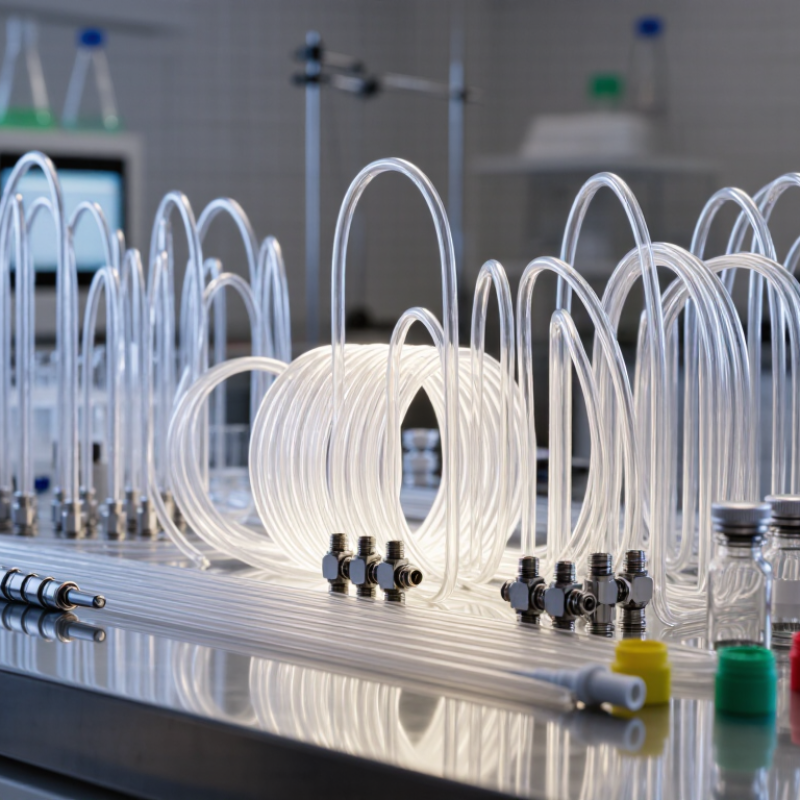
Medical chromatography tubing is the narrow, controlled pathway connecting pumps, columns, detectors, and collection vessels. It carries mobile phases and samples without adding particles, extractables, or unwanted chemical reactions. In medical laboratories, the tubing must match pressure, solvent strength, temperature, and biological sensitivity. Common choices include PTFE, PEEK, FEP, silicone, and stainless steel. Each material behaves differently.
The market is expanding. MarketsandMarkets’ 2024 Chromatography Market report projects growth from about US$12 billion in 2024 to nearly US$18 billion by 2029. This growth reflects rising demand for pharmaceutical testing, biomolecule analysis, and quality control. Grand View Research also identifies clinical and pharmaceutical applications as major chromatography revenue areas. These figures do not prove that every laboratory needs premium tubing. They show why dependable fluid paths matter.
A well-selected tube reduces dead volume and protects peak shape. It also supports repeatable pressure readings and cleaner maintenance records. Technicians should inspect inner walls, fittings, bends, and connection points before each critical run. Tiny scratches can trap residues. Poorly cut ends can create leaks. No material is perfect. PTFE may resist solvents but lack flexibility, while silicone bends easily but may absorb some compounds. Selection should follow documented compatibility testing, validated cleaning procedures, and applicable requirements such as USP <665> for polymeric components in pharmaceutical manufacturing systems. That standard is not a substitute for method-specific evaluation.
Why Choose Medical Chromatography Tubing for Global Labs? - Medical Chromatography Tubing: Definition and Laboratory Role
Medical chromatography tubing is a fluid-transfer component used to connect pumps, injectors, columns, detectors, fraction collectors, and other parts of a chromatography system. Its material, internal diameter, chemical compatibility, and cleanliness can directly influence flow stability, sample integrity, and system reliability.
| Data Dimension | Typical Medical Chromatography Tubing Information | Laboratory Role and Selection Considerations |
|---|---|---|
| Definition | Small-bore tubing designed to transport mobile phases, samples, buffers, and collected fractions within chromatography equipment. | Provides controlled fluid routing between system components while helping maintain a stable analytical flow path. |
| Common Materials | Polytetrafluoroethylene (PTFE), fluorinated ethylene propylene (FEP), polyether ether ketone (PEEK), stainless steel, and biocompatible thermoplastic materials. | Material choice should match solvent compatibility, pressure requirements, flexibility needs, extractables limits, and sterilization conditions. |
| Typical Internal Diameter | Common small-bore sizes range from approximately 0.10 mm to 1.00 mm; larger sizes may be used for preparative or fraction-transfer lines. | Smaller internal diameters reduce dead volume but can increase pressure drop and sensitivity to clogging. Larger diameters support higher flow but may increase dispersion. |
| Flow-Path Function | Used in solvent inlet lines, pump-to-injector connections, injector-to-column lines, column-to-detector lines, and waste or fraction-collection paths. | Correct routing helps prevent leaks, unnecessary connections, air entry, and inconsistent delivery of the mobile phase or sample. |
| Pressure Capability | Pressure performance depends on material, wall thickness, temperature, connector design, and tubing dimensions. High-pressure liquid chromatography requires pressure-rated components. | Tubing should be selected according to the complete system pressure rating, with secure fittings and no visible deformation or kinking. |
| Chemical Compatibility | Compatibility varies with solvents, acids, bases, salts, buffers, cleaning agents, and biological fluids. | A compatible tube reduces swelling, embrittlement, permeation, contamination, and premature failure during routine operation. |
| Biocompatibility Needs | For biomolecule, pharmaceutical, or diagnostic workflows, tubing may need low extractables, low adsorption, and documented material quality. | Suitable surfaces help protect sensitive proteins, peptides, nucleic acids, cells, and other biological samples from unwanted interaction. |
| Dead Volume | Dead volume is the internal volume that can delay, dilute, or broaden a sample band. It is affected by tubing length and internal diameter. | Short, narrow, and properly installed tubing is generally preferred when low dispersion and fast response are important. |
| Temperature Considerations | Usable temperature ranges are material-specific. Common laboratory tubing may tolerate ambient operation, while some materials support elevated-temperature methods. | The selected tubing should remain dimensionally stable at the method temperature and during cleaning or sanitization cycles. |
| Sterilization and Cleaning | Cleaning may involve water, aqueous buffers, compatible organic solvents, or validated sanitizing solutions. Sterilization suitability depends on tubing material and construction. | Validated cleaning and sterilization procedures help reduce carryover, microbial contamination, and cross-sample interference. |
| Connection Requirements | Common connection approaches include compression fittings, flanged connections, ferrules, luer-style connections, and instrument-specific fittings. | Matching the tubing outer diameter and fitting geometry helps prevent leaks, excessive internal volume, and accidental disconnection. |
| Quality Attributes | Important attributes include dimensional consistency, smooth internal surfaces, cleanliness, transparency when visual inspection is useful, and reliable lot documentation. | Consistent tubing supports reproducible flow behavior and simplifies maintenance, troubleshooting, and method transfer between laboratories. |
| Global Laboratory Value | Standardized tubing specifications can support equipment compatibility, repeatable workflows, and consistent laboratory practices across different regions. | Selecting tubing by measurable specifications rather than brand identity can improve procurement flexibility while maintaining technical and regulatory requirements. |
FAQS
PTFE and PFA resist aggressive solvents. Silicone supports flexible peristaltic movement. Polyurethane offers durable, transparent fluid paths. Each material still has limitations.
Match the material with solvents, buffers, cleaning agents, pressure, and temperature. Do not trust a familiar material automatically. Real testing is safer.
A narrow bore reduces dead volume and sample loss. However, it can increase pressure. Even a 0.1-millimeter difference may affect flow and peak shape.
Check chemical compatibility and connector fit. Measure the internal diameter. Confirm pressure and temperature limits. A rushed installation can create later troubleshooting.
Smooth internal surfaces may reduce particle retention and unwanted adsorption. Consistent dimensions support stable flow rates. Small variations matter.
No. Transparency helps operators see bubbles and particles. Hidden residues may remain inside. Visual inspection is useful, but it is not enough.
It depends on the material and sterilization method. Autoclaving, irradiation, and chemical processing affect polymers differently. Repeated exposure may cause brittleness or swelling.
Keep batch details, certificates, cleaning history, replacement dates, and inspection findings. Record discoloration, swelling, and sharp bends. The paperwork can feel excessive, but it helps during investigations.
Revalidate after changing solvents, pressure, cleaning procedures, or tubing dimensions. Replacement stock may have different tolerances. “Universal” tubing is not always precise.
Conclusion
Medical Chromatography Tubing is a critical component in laboratory systems used to transfer solvents, samples, and mobile phases with accuracy and consistency. Designed for medical and analytical applications, it helps maintain stable flow paths while minimizing contamination, adsorption, pressure loss, and unwanted interactions with sensitive compounds. Common materials and design features are selected according to chemical resistance, flexibility, temperature tolerance, internal smoothness, and connection reliability.
For global laboratories, the right tubing supports reproducible chromatographic results and efficient instrument performance. Selection should consider compatibility with solvents and samples, operating pressure, sterilization needs, dimensional accuracy, service life, and integration with existing equipment. Safety and regulatory considerations are equally important, including clean manufacturing, traceability, low extractables, and suitability for the intended laboratory environment. By evaluating these factors carefully, laboratories can improve analytical reliability, protect sample integrity, reduce maintenance risks, and establish a dependable tubing solution for diverse medical research and testing workflows.